Back to all stories

THE HOLLOW HOURS

THE HOLLOW HOURS

ongoing13 Episodes28 min read to read
TerrifyingYou might scream
HorrorFantasyMystery

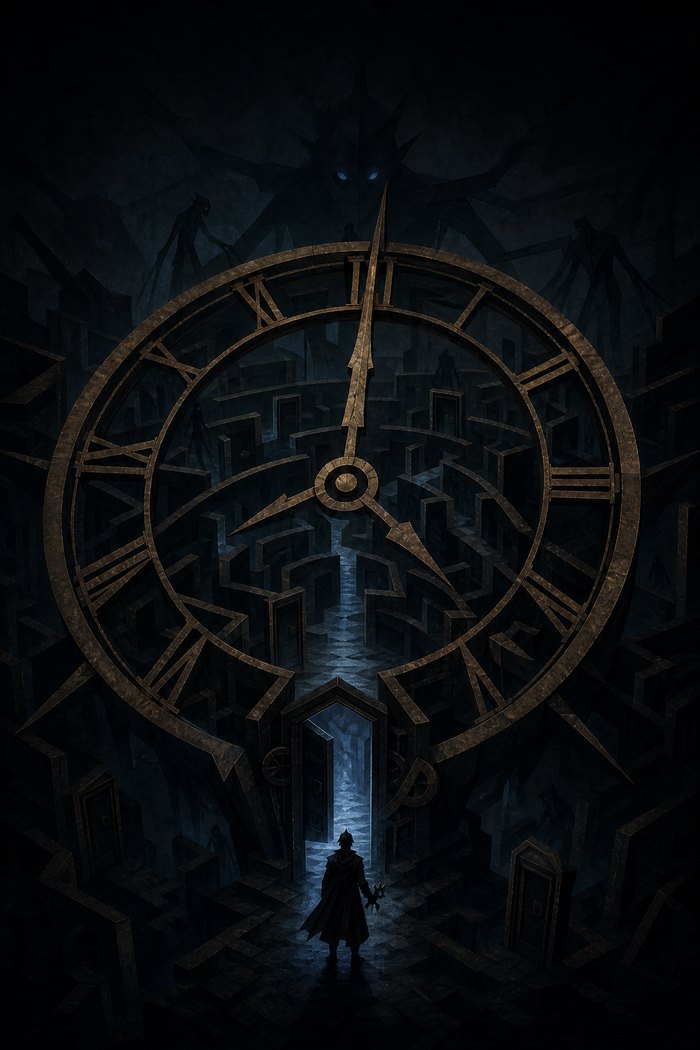
A clockmaker discovers that time is not linear—it is a maze created by beings who feed on human suffering, and he has accidentally opened the door.

Share:

All Episodes

12 Episodes
Episode 13 min read

The Clockmaker's Inheritance

Share:

The workshop smelled of old wood and older secrets. Elias Blackwood had spent thirty years repairing timepieces—winding mechanisms that measured seconds into minutes, hours into days—but he had never encountered anything like the clock that arrived on his doorstep on the night of the winter solstice.

It came without a return address. Without a sender. The wooden case was dark oak, ancient beyond measure, with brass fittings that had tarnished to the color of dried blood. When Elias lifted the lid, he found no gears. No springs. No intricate dance of metal that he had spent his entire life mastering.

Instead, there was only a face. A clock face with a single hand, pointing nowhere. No numbers marked the circumference. No hour markers broke the endless void of its cream-colored surface. And as Elias stared into that empty face, he heard it—the ticking. But it wasn't coming from within the clock. It was coming from within himself. From somewhere deep in his chest, in the hollow space where his heart should have been.

The workshop grew cold. The candles guttered. And Elias Blackwood, master horologist and keeper of time's secrets, made a decision that would haunt him for the rest of his days. He wound the clock.

The sound that emerged was not the gentle click of a mechanism engaging. It was the groan of something ancient stirring from a long sleep. The single hand began to move—backwards. Elias watched as it spun in reverse, tracing an arc that seemed to pull at something fundamental within him. His memories began to unravel. His wife's face blurred. His daughter's laughter faded to silence. Every precious moment he had collected over sixty-three years of life began to dissolve like frost under a sudden heat.

He slammed the lid shut. The ticking stopped. But something had changed. Elias could feel it in his bones—a shift in the fabric of reality itself. When he looked out his workshop window, he saw that the street outside was empty. Not just of people, but of everything. The lampposts were gone. The buildings had vanished. The world beyond his window was nothing but grey mist, stretching infinitely in every direction.

And then he heard the voice. It came from everywhere and nowhere, from the clock itself and from the empty air around him, from the very hollow that had replaced his heart.

"Welcome, Clockmaker. The hour is hollow, and you have opened the door."

Episode 22 min read

The Architecture of Shadows

Share:

The mist had a texture, almost like velvet pressed against his skin. Elias walked through it, though he could not say for certain how long or in what direction. Time had become unreliable—seconds stretched into what felt like hours, then compressed into heartbeats. His workshop existed somewhere behind him, though he could no longer see its warm glow. It might as well have been a dream.

The voice had not returned, but Elias felt its presence like a weight upon his shoulders. The Hollow Hours, it had called them. He understood now what that meant. Time was not the steady march he had always believed it to be. It was a construction. An architecture built by beings who fed on human suffering, and he had inadvertently found the key to their domain.

The mist began to part, revealing shapes in the darkness. At first, Elias thought they were buildings—structures of grey stone rising from the nothing. But as he approached, he realized they were clocks. Massive clocks, hundreds of feet tall, their faces frozen at different hours. Some showed times that could not exist—twenty-five o'clock, negative three o'clock, the hour of the year that had no name. Others displayed times that existed only in nightmares: the hour of the last breath, the hour of the unmade choice, the hour of the erased memory.

Elias walked among them, and with each step, he felt the weight of their meaning. These were not merely timepieces. They were prisons. Each clock contained something—a moment stolen from someone's life, a second of existence that had been extracted and imprisoned within the mechanism. He could hear them, faintly, calling out from within their brass and iron cages. The whisper of a child who would never grow old. The final words of a lover taken before their time. The scream of someone who had died a thousand deaths in a single second.

And at the center of this impossible landscape, Elias saw the tower. It rose higher than any of the clocks, its peak lost in a darkness that seemed absolute. At its base, an archway waited, and above that archway, words were carved in a language that Elias somehow knew but had never learned.

"The Hollow Hour. Where time stands still and the void grows fat."

Elias understood what he had to do. He had opened the door. Now he had to walk through it.

Episode 33 min read

The Keepers of the Hollow

Share:

They emerged from the shadows between the clocks—figures that seemed to be made of the same grey mist that filled this place. They had no faces, only smooth surfaces where features should have been, yet Elias felt their attention like the pressure of a dozen staring eyes. They moved without walking, gliding across the stone floor, their forms never quite solid, never quite stable.

"You are not one of us," the tallest of them said, though Elias could not tell if they spoke with a voice or if the words simply appeared in his mind. "You are not meant to be here, Clockmaker. You are meat for the Hollow."

Elias found his voice, though it came out as a whisper. "I opened the door. I wound the clock."

"A mistake," another figure said. "A common mistake. Many have wound that clock before you. Many have come to this place."

"What happened to them?"

The figures turned to each other, communicating in gestures that Elias could not interpret. When they turned back, the tallest one raised a hand, pointing toward the base of a nearby clock. Elias looked and saw the bones. They were scattered across the ground like fallen leaves, human remains that had been picked clean and left to bleach in the grey light. Thousands of them. Millions. The remains of all those who had made the same mistake he had made.

"The Hollow consumes all who enter without permission," the figure said. "The Architects designed this place to feed. To grow fat on the suffering of those who cannot escape. You are no different from the others, Clockmaker. You will join them in time."

Elias felt the truth of those words pressing against him. He was sixty-three years old, alone in a world that was not his own, surrounded by beings that had existed since time itself was born. He should have been afraid. He should have despaired.

But Elias Blackwood had spent thirty years with his hands in the entrails of timepieces, understanding how things worked, how things could be fixed. And he understood now that this place was a machine. A machine could be broken. A machine could be repaired. A machine could be stopped.

"The clock that brought me here," he said, his voice growing stronger. "The one I wound. Where is it?"

The figures went silent. For the first time, Elias sensed something like uncertainty in their movements.

"The clock does not leave the door," one of them said. "It remains where it was found."

"But I can find it again," Elias said. "If I can find it, I can understand it. And if I can understand it, I can close what I opened."

The figures began to close around him, their forms becoming more solid, more threatening. But Elias was already moving, running back through the maze of impossible timepieces, searching for the workshop he had left behind, the place where the door still waited.

Episode 43 min read

The Door Between Hours

Share:

The workshop was exactly as he had left it. Elias stumbled through the archway that led back from the Hollow Hours and found himself standing among his tools, his workbenches, his life's collection of timepieces. The candles were still burning. The wooden case of the impossible clock still sat on his workbench, its lid closed, its single hand frozen at the moment he had first seen it.

He approached the clock slowly, examining it with the eye of a craftsman. It was beautiful in a terrible way—the wood was ancient beyond measure, the brass fittings intricate beyond comprehension. But it was a machine. Despite its impossibility, despite the realm it had opened, it was still a mechanism that could be understood.

Elias reached for his tools. His picks, his screwdrivers, his magnifying glass. He would take this clock apart piece by piece if he had to. He would understand its secrets. And when he did, he would find a way to close the door.

As he lifted the lid, the ticking began again. But this time, Elias was ready. He listened not with fear but with focus, hearing the rhythm of the mechanism, feeling the vibrations that passed through the brass and into his fingertips. The clock was not just a door. It was a lock. And like all locks, it could be picked.

Hours passed. Or perhaps minutes. Or perhaps days. Time moved differently when you were working on something that controlled time itself. Elias worked without stopping, taking measurements, making notes, tracing the paths of energy that flowed through the clock's mysterious mechanism. And as he worked, he began to see patterns. The clock was not just a device for opening a door. It was a map. A diagram of the architecture that held the Hollow Hours together.

And within that architecture, Elias found something unexpected. A flaw. A weakness. A single point where the entire structure could be disrupted, where the door could be forced shut, where the feeding ground of the Architects could be isolated from the world of men.

But the price of closing that door was high. To seal the Hollow Hours, someone would have to become part of the mechanism. Someone would have to take their place at the center of the architecture, holding the door closed for eternity. Someone would have to give up their time—their life, their memories, their existence—to feed the machine that kept the door shut.

Elias stared at his reflection in the clock's brass surface. He saw a sixty-three-year-old man, tired and alone, with nothing left to lose and everything to gain. His wife was dead. His daughter had stopped speaking to him years ago. His workshop was the only home he had known for three decades.

Perhaps, he thought, this was not a sacrifice at all. Perhaps this was simply an ending to a life that had already ended.

Episode 53 min read

The Architect's Warning

Share:

The voice returned on the third night of his work. Elias had not slept, had not eaten, had done nothing but study the clock and its impossible mechanisms. His hands were steady despite his exhaustion, his mind focused on the task at hand. He had become what he had always been—a clockmaker, lost in the work, unable to think of anything else until the job was done.

"You are clever," the voice said, and this time it came with a face. A figure appeared in the doorway of the workshop—a man, though not a man, with eyes that held the light of dying stars and a smile that promised nothing but pain. "The others who came before you were not so clever. They simply wandered into the Hollow and were consumed. But you—you are trying to fix what cannot be fixed."

Elias did not look up from his work. "Everything can be fixed. That is the nature of machines."

"Nothing is fixed in the Hollow Hours," the figure said. "Nothing is ever fixed. Everything is always in motion, always feeding, always growing. You cannot close the door, Clockmaker. You can only delay the inevitable."

"The flaw in your architecture says otherwise."

The figure went silent. Elias continued his work, feeling the presence of the Architect—that was what it was, he realized, not just a being but the being, the creator of the Hollow Hours, the master of the maze—standing over him, watching his every move.

"You have found the weakness," the Architect said at last. "But knowing the weakness is not the same as exploiting it. To seal the door, you must become part of it. Your consciousness must merge with the mechanism. Your memories will be distributed among every hour in the maze, and you will feel the suffering of every soul we have ever consumed. It will not be one death. It will be a million deaths, forever, for all eternity."

Elias set down his tools. He looked at the Architect for the first time, truly looked, and saw not a monster but a prison warden. A guard for a system that existed outside of good and evil, designed simply to feed and grow and endure.

"You created this system," Elias said. "You built the Hollow Hours to feed on human suffering. But you did not create the suffering itself. The suffering exists whether you feed on it or not. By building your architecture, you have given meaning to the meaningless. You have given purpose to the purposeless. You have created order from chaos."

The Architect smiled. "And now you propose to destroy that order? To return the chaos to the world? Do you think humanity wants that? Do you think they would thank you for freeing them from the only structure that gives their pain meaning?"

"I think," Elias said quietly, "that humans would rather have their pain be their own. Not yours to harvest. Not yours to grow fat upon."

He picked up his tools again and returned to work.

Episode 63 min read

The Weight of a Thousand Hours

Share:

The work took seven days. Or seven years. Or seven lifetimes—Elias could no longer tell the difference. When he finally looked up from the clock, he found that his hands had aged, his fingers grown stiff, his eyes dimmed by the strain of focus that had stretched far beyond what any human body should endure.

But the work was complete. He understood the mechanism now. He saw the flaw and how to exploit it. And he had prepared himself for what came next.

The Hollow Hours still waited beyond the door. The Architect still watched. The maze of impossible clocks still held its prisoners, their voices calling out from within their brass prisons. But Elias was no longer afraid. He understood now that fear was just another form of feeding—the Architects fed on fear as readily as they fed on suffering. To defeat them, he had to accept what was coming, not with fear but with purpose.

He opened the clock one final time and began to speak. Not to the Architect, not to the prisoners, but to the mechanism itself. He spoke the language of gears and springs, the dialect of hours and minutes. He explained what he intended to do and asked the machine to help him do it.

The clock responded. Its single hand began to move again, spinning backwards through the hours, pulling at the fabric of the architecture that held the Hollow Hours together. Elias felt the connection form between himself and the mechanism—a bond that would grow stronger with each passing moment until it could never be broken.

The Architects came for him then. All of them, emerging from the shadows, their forms solid and terrible, their voices crying out in a language of warning and condemnation. But Elias did not listen. He was already becoming part of the machine, his consciousness spreading across the architecture, his memories fragmenting into a thousand pieces that would hold the door shut forever.

The last thing he felt was not pain. It was peace. The peace of a clockmaker who had finally found the perfect mechanism—one that would never need winding, never need repair, never need anything but his presence to keep it running.

The door closed. The Hollow Hours were sealed. And Elias Blackwood, the Clockmaker of the Hollow, took his place at the center of the maze, holding the door shut with the weight of a thousand hours.

Episode 73 min read

The First Watch

Share:

Centuries passed, or perhaps only moments. Time moved differently now that Elias was part of the mechanism. He could feel the hours stretching and contracting around him, the endless cycle of feeding and growing that was the Hollow Hours. But he could also feel his own presence holding the architecture together, preventing it from expanding, keeping the door sealed against all who would try to open it.

The prisoners still called out from within their clocks. Elias listened to them now, not with horror but with compassion. Each voice was a reminder of why he had done this. Each scream was a testament to the suffering he was preventing. He carried their memories alongside his own, a weight that should have been unbearable but had become instead a purpose. A reason to continue.

The Architects still wandered the maze, searching for weaknesses, testing the seal, probing for any crack that might let them break through. But they could not find one. Elias had built his position too well, had merged himself too completely with the mechanism. He was not just holding the door—he was the door, as much a part of the architecture as the gears and springs and brass plates that made up its structure.

But even in this eternal vigil, Elias found moments of peace. He could watch the hours move through their cycles, the single hand on his clock moving backwards and forwards through time. He could feel the rhythm of existence itself, the pulse of the universe as it marked the passing of each precious second. And in those moments, he remembered why he had become a clockmaker in the first place. Not to control time, but to understand it. Not to master it, but to work alongside it.

The Architect came to visit him often. They would stand together in the grey mist, two beings who existed outside of normal time, discussing the nature of the prison they both maintained. The Architect never tried to break through again—it understood that such attempts were pointless. But it never stopped watching, either. It never stopped testing.

"You are happy," the Architect said one day, with something that might have been surprise in its voice. "I have never seen a prisoner who was happy."

Elias smiled. It was a strange expression for a being who had no face, but somehow it managed to convey itself. "I am not a prisoner. I am a keeper. There is a difference."

"What difference?"

"A prisoner is held against their will. A keeper chooses to hold. I chose this, Architect. I chose to become part of this system, to use my understanding of mechanisms to seal the door and protect the world from your feeding grounds. This is not my prison. This is my purpose."

The Architect said nothing. But Elias knew it understood now. The Architects had built their system to feed on suffering, but they had never understood what it meant to choose suffering for a purpose. They had never understood sacrifice.

They never would.

Episode 83 min read

The Whisper in the Walls

Share:

Something was wrong. Elias felt it before he understood it—a disturbance in the rhythm of the mechanism, a discord in the harmony of the hours. The Hollow Hours had existed for millennia before he arrived, and he had held them sealed for centuries since. But now, for the first time, something was changing.

The whispers came first. Not from the prisoners—their voices had become familiar to him, almost comforting in their constancy. These whispers were different. They came from the walls themselves, from the architecture that held the maze together, from the very fabric of the realm he had sworn to protect.

Elias listened. He had learned to listen in his centuries of vigil, to hear the small changes that might indicate a greater problem. And what he heard chilled him.

"They are breaking," the walls whispered. "The seals are weakening. The door is cracking."

This should have been impossible. Elias knew every inch of the mechanism he had become part of. He had felt the architecture grow stronger over the centuries, his presence reinforcing the structure, his purpose strengthening the seals. But the walls were not lying. He could feel it now, a tremor in the foundation of his vigil.

Something was testing the door. Not the Architects—they had long since given up on that approach. Something else. Something from the world beyond the door, from the realm of humans where time moved in a single direction and suffering was not harvested but simply endured.

Elias reached out with his consciousness, feeling the edges of the sealed realm, testing the boundaries of his domain. And there, at the very edge, he found it. A crack. A single point of weakness where the seal had begun to fail.

Someone was trying to open the door from the other side. Someone in the world of humans had found the clock and was attempting to wind it again. The mechanism was responding, the hand beginning to move, the architecture trembling as it had not trembled in centuries.

Elias gathered his strength. He would have to go to the crack and reinforce it, use his own presence to hold the seal together until the threat passed. But as he moved toward the edge of his domain, he felt something he had not expected—curiosity. Someone in the human world had found the clock. Someone had wound it again. Someone was trying to enter the Hollow Hours.

Who had discovered his secret? And why?

Episode 93 min read

The Heir of the Hollow

Share:

Her name was Mira Blackwood. Elias felt the truth of it as soon as he saw her face through the crack in the door. She was his descendant, generations removed, but the bloodline was clear in the shape of her eyes, the set of her jaw, the way she held herself like someone who understood precision and patience.

She had found the clock in his workshop. The workshop that still existed in the world beyond, preserved somehow, maintained by the small fortune he had left behind for its upkeep. And she had done what he had done—she had wound it.

But unlike Elias, Mira had not entered the Hollow Hours blind. She had studied his notes, his journals, the careful documentation he had left behind in the hope that someone would understand what he had done and why. And she had understood. She had recognized the architecture for what it was and she had come to join him.

"You cannot be here," Elias said, but his voice was weak, distracted by the effort of holding the crack closed. "The Hollow will consume you. The Architects will feed on your suffering and add you to their collection."

Mira stood at the threshold, her hand on the clock that served as the door. She looked not at him but at the maze behind him, at the endless rows of impossible clocks, at the grey mist that filled every corner of the realm. She looked at the prisoners in their brass cages, at the Architects watching from the shadows, at the architecture that had existed since the beginning of time.

"I know," she said. "I read your journals. I understand the risk."

"Then why did you come?"

Mira smiled, and it was the same smile Elias had worn centuries ago, when he had made his choice. "Because someone needs to watch the watchman. Because you have held this door alone for too long. Because the seal is weakening, and you need help."

She stepped through the door. The crack widened, and Elias felt the weight of the Hollow Hours pressing against him, trying to break through, trying to consume his descendant before he could stop it. But Mira was already beside him, her consciousness merging with the mechanism, her presence adding strength to the seal.

"I am Mira Blackwood," she said, and her voice rang through the maze like a bell. "I am the heir of the Hollow. And I have come to take my watch."

The Architects came then, drawn by the presence of fresh meat, by the possibility of new suffering. But they found not one keeper but two, standing back to back at the center of the architecture, holding the door closed with the combined weight of their purpose.

The battle for the Hollow Hours had begun.

Episode 104 min read

The Architects' Gambit

Share:

They were cleverer than Elias had ever given them credit for. For centuries, he had watched them wander the maze, testing the seals, probing for weaknesses, and he had believed they were simply waiting. Waiting for an opportunity, yes, but waiting nonetheless. He had not understood that they were learning. Studying him. Understanding how he thought, how he worked, how he might be defeated.

The assault came not from one direction but from all directions at once. The Architects poured out of the shadows, their forms solid and terrible, their voices rising in a cacophony of hunger and rage. They had fed on suffering for millennia, and they would not accept having their feeding ground restricted any longer.

Elias and Mira held the center of the architecture, their consciousnesses merged with the mechanism, their presences reinforcing the seals at every point where the Hollow Hours pressed against the barrier. But the Architects had prepared for this. They had studied the architecture and found its weak points—not the one Elias had used, but others, smaller gaps that he had not thought to protect.

The seal began to crack. Not in one place but in dozens, a web of fractures spreading through the mechanism like ice over a frozen lake. Elias felt each crack as a wound in his own consciousness, each failure a pain that he could not escape. Mira felt it too, her presence flickering as the strain grew too much to bear.

"We cannot hold them all," she said, and there was fear in her voice for the first time. "There are too many."

Elias understood. They had two choices. They could fall back, protect only the central seal, and allow the outer edges of the Hollow Hours to collapse. Or they could spread themselves thin, try to hold every crack at once, and risk being overwhelmed entirely.

Neither choice was good. Neither choice was right. But there was a third option, one that Mira had discovered in her studies of his journals, one that he had hoped would never be necessary.

"The clock," he said. "The one she used to enter. Can you reach it?"

Mira understood. She turned her consciousness toward the door, toward the clock that served as the barrier between the Hollow Hours and the world of humans. She could feel it, the mechanism that had brought her here, the device that could send her back.

"If I close the door," she said, "I will be trapped in the human world. I will not be able to return. The seal will weaken without my presence."

"But you will live. You will escape. And you can continue your watch from the other side."

Mira hesitated. She had only just arrived, only just taken her place at his side. The thought of leaving was almost unbearable. But she understood what he was asking. She understood the sacrifice he was offering.

"I will watch," she said. "I will find others who understand. I will build a system of protection for the door, a way to prevent others from accidentally winding the clock and opening the way."

Elias felt her consciousness begin to withdraw, felt the weight of her presence lift from the mechanism. It hurt more than he had expected—it had been so long since he had felt any connection to another being that her leaving felt like losing a part of himself.

"Go," he said. "Save what you can save. And remember me."

The door closed. Mira was gone. And Elias Blackwood stood alone at the center of the Hollow Hours, facing an army of Architects who had waited centuries for this moment.

Episode 113 min read

The Final Stand

Share:

They came for him in waves. First the lesser Architects, the ones who had no faces, no names, who existed only to feed and grow and serve the greater hierarchy. Elias held them back with the strength of his purpose, the weight of his vigil, the accumulated force of centuries of determination.

Then came the greater Architects, the ones who had names that had been forgotten by all but themselves, who had built the maze in the first place and knew every corner, every shadow, every weakness. They attacked not with physical force but with psychological warfare, showing him visions of the world he had protected, the lives he had saved, the suffering he had prevented.

"You have accomplished nothing," they said, their voices echoing through the maze. "The suffering continues. Humans still endure pain, still lose loved ones, still face the chaos of existence. You have only redirected it, not eliminated it. Your sacrifice was meaningless."

Elias knew it was not true. He had felt the suffering that would have occurred if the Hollow Hours had remained open—the billions who would have been consumed, the millions of years of pain that would have been harvested. He had prevented all of that. He had given humanity a chance to face their suffering on their own terms, without the Architects feeding on their agony.

But knowing it was not true did not make the attacks easier to withstand. The visions came faster, stronger, more detailed. He saw his daughter dying, alone and afraid, in a world where he had never existed. He saw his wife suffering, crying out for help that would never come. He saw the workshop burning, his life's work reduced to ash.

And through it all, he held the seal. He held the door. He held the line.

Days passed, or centuries. Time had no meaning in the Hollow Hours, especially not for a being who existed as part of the mechanism. Elias fought on, his consciousness fragmenting under the strain, his memories scattering like leaves in a storm. But he did not fall. He could not fall. If he fell, the door would open, and everything he had sacrificed would be for nothing.

So he held on. Through the pain, through the visions, through the endless assault of the Architects' rage. He held on, and he waited, and he hoped that somewhere in the world of humans, Mira was building the system she had promised to create.

Episode 123 min read

The Hollow Hours End

Share:

Mira came back. Not through the door—that was closed forever, sealed by her departure and by the centuries of accumulated power that Elias had built in her absence. She came through the walls themselves, through the architecture that separated the Hollow Hours from the world of time.

Elias felt her presence before he saw her face. It had been so long—millennia, perhaps, or merely a moment—that he had almost forgotten what connection felt like. But there she was, Mira Blackwood, her consciousness reaching out to his across the vast gulf of eternity.

"I kept my promise," she said, and her voice was not a voice but a feeling, a warmth that spread through the mechanism and into Elias himself. "I found others. I built the system. The clock is protected now, hidden where no one will ever find it. The door will never be opened again."

Elias felt tears that he could not cry, emotions that he could not express. The Architects had retreated in her presence, driven back by the knowledge that their gambit had failed, that the door would remain sealed forever. For the first time in millennia, the Hollow Hours were silent.

"You came back," he said. "After all this time."

"I never left," Mira replied. "I watched from the other side. I felt your struggle, your pain, your endless determination. And I knew that someday, I would find a way to return."

"The Architects—"

"Are broken. Their architecture is crumbling. Without the door to feed through, without the constant supply of suffering from the human world, they will fade. They will become nothing more than memories of hunger that can never be satisfied."

Elias looked at the maze around him. The clocks were still there, their prisoners still calling out, their brass faces still frozen at impossible hours. But the mist was clearing, the shadows retreating, the endless pressure of the Architects' will no longer pressing against the seals.

"What happens now?" he asked.

Mira smiled. "Now we rebuild. Now we free the prisoners, return their stolen hours to the flow of time, give meaning to the meaningless. Now we do what you always wanted to do, Clockmaker. We fix what is broken."

The task would take centuries. The work would never truly be done—there would always be suffering in the world, always be chaos and pain and loss. But it would be their suffering now, not the Architects'. It would be human suffering, human joy, human existence in all its mess and beauty.

Elias Blackwood, the Clockmaker of the Hollow, took his descendant's hand—or what passed for a hand in this realm of shadows and time—and together they began the long work of repair.

The Hollow Hours were ending. And something new was beginning.

Comments on THE HOLLOW HOURS

Please sign in to leave a comment

Loading comments...